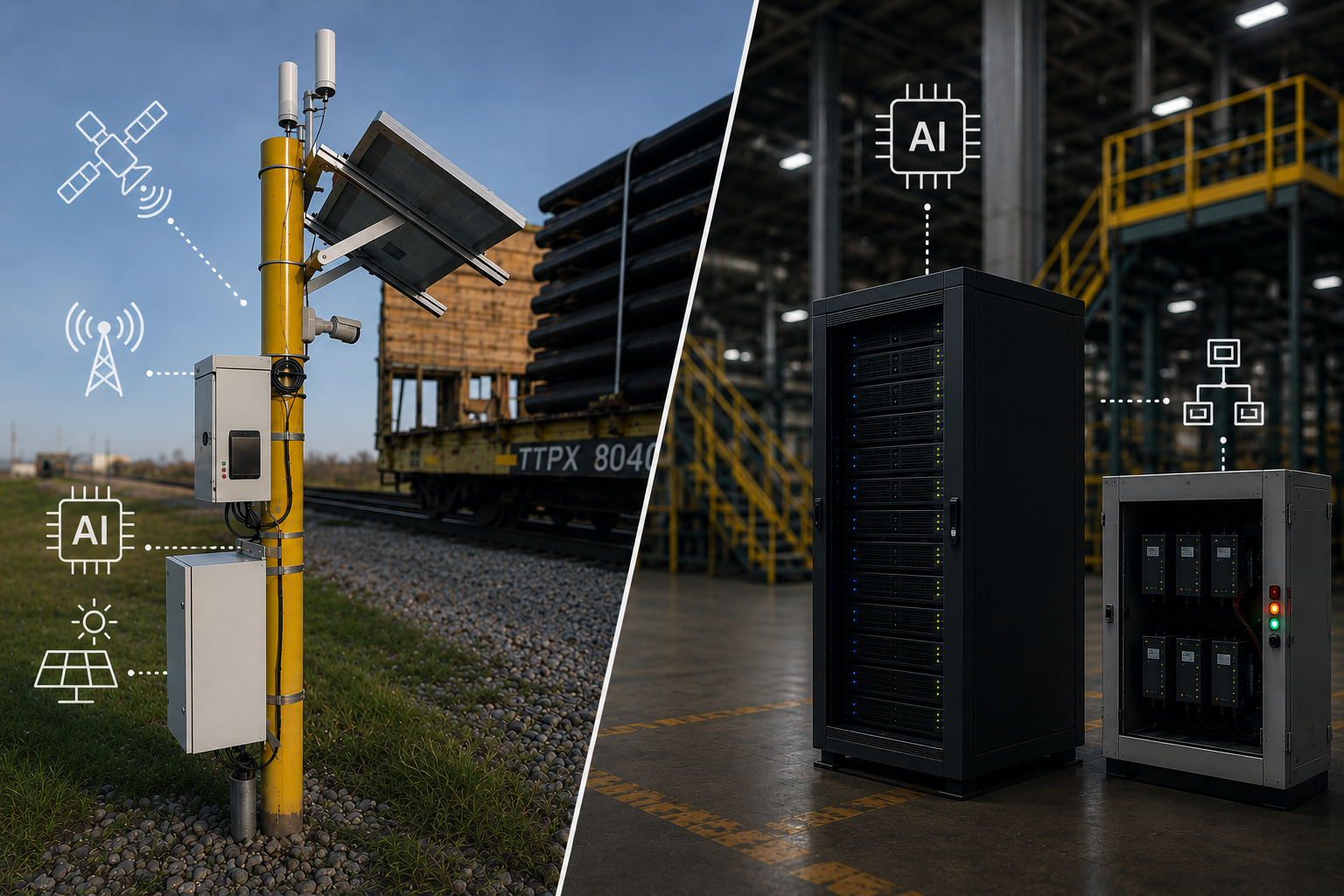
When you hear the term "edge computing" or "AI at the edge," it usually refers to an AI solution running on a physical device close to where the data is being generated.
For AI vision, that could mean a small GPU-enabled device inside a NEMA enclosure on the side of a railroad track, powered by solar panels and accessed through a cellular modem or Starlink connection.
But edge computing can also describe a large multi-GPU server located inside an industrial facility, processing 25 parallel camera streams from process equipment while communicating with a PLC.
In other words, being "at the edge" is less about the size or type of hardware and more about where the AI models are running. If the AI is running close to the cameras, equipment, process, or source of data, it is operating at the edge.
For industrial environments, that distinction matters.
Why Edge Computing Matters for Industrial AI Vision
There are several reasons edge computing is important for industrial AI vision use cases. The biggest reasons usually come down to security, bandwidth, power, reliability, and network design.
Industrial environments are different from typical office or cloud software environments. Many facilities have strict network segmentation, limited connectivity, remote equipment, harsh conditions, and safety-critical systems that cannot depend on unreliable internet connections.
That is where edge computing becomes valuable.
Security and OT Network Requirements
The first major reason edge computing matters is security.
If an AI vision solution needs to send data to a PLC for control purposes, trigger an alarm, or stop equipment, it will almost certainly need to live on the OT network, also known as the operations technology or automation network.
Most enterprise OT networks are isolated from the internet to prevent outside access to physical control systems. This is a good thing.
If you want to run an AI vision solution in the cloud while also having it communicate with a PLC, you may end up fighting against internal security policies, network segmentation requirements, and cybersecurity concerns. That can create a long approval process and may force teams to build complicated workarounds just to keep everyone comfortable.
Edge computing helps solve that problem.
If the AI model can run on dedicated hardware inside the isolated OT environment, and if that solution does not need to communicate with the internet, then the project usually has a much better chance of being approved internally. It is easier to align with corporate security policies because the data processing happens locally and the solution can be designed to fit within the existing network architecture.
At Canopy Vision, we have experience navigating this landscape and building AI vision solutions that can be deployed in these types of industrial environments.
Bandwidth and Connectivity Constraints
The second reason edge computing is important is bandwidth.
Many industrial AI vision use cases are not located near strong networking infrastructure. A camera may be watching equipment in a remote part of a facility, along railroad tracks, in a mining operation, on a locomotive, or in another location where consistent high-bandwidth connectivity is difficult or expensive.
Streaming camera footage to the cloud 24/7 can consume a significant amount of bandwidth. If that stream is running over a cellular network, the ongoing costs can become expensive quickly.
Running the AI model locally on a GPU-enabled device near the camera can dramatically reduce the need to send continuous video streams over the internet. Instead of sending every frame to the cloud, the edge device can process the video locally and only send the output that matters.
That output might be an alert, a measurement, a detection event, a dashboard update, or a short video clip tied to a specific event.
This approach can make the solution more practical, more cost-effective, and easier to maintain over time.
Power Limitations in Remote Environments
Power is another important factor.
In many industrial use cases, there is no convenient power source near the location where the AI vision system needs to operate. This can happen in mining operations, rail environments, outdoor material handling areas, remote yards, or mobile equipment applications.
For these types of deployments, low-power edge devices can make a major difference.
There are devices on the market, such as NVIDIA Jetson devices, that can run AI models while consuming a relatively small amount of power. At Canopy Vision, we like using these types of devices for projects that require solar power or remote field deployment.
Depending on the configuration, these devices may consume anywhere from about 5 watts to 60 watts while still running camera streams and AI models locally. They are often small, fanless, and well-suited for installation inside a NEMA enclosure.
Compared to a standard GPU server, which may consume hundreds of watts of power, low-power edge devices make it possible to run useful AI vision models in places where traditional computing hardware would not be practical.
That opens the door for AI vision in locations that would otherwise be difficult or expensive to monitor.
Reducing Strain on the Facility Network
Even when power and internet connectivity are available, edge computing can still be the better choice.
If a facility has many cameras streaming 24/7 to the cloud, that can place a heavy burden on networking equipment, firewalls, and internet connections. Video is data-heavy, and industrial camera systems can quickly create large amounts of traffic.
Running the AI models locally keeps the camera streams on the same LAN or facility network instead of pushing all of that video data to the cloud.
This can reduce bandwidth consumption, lower cloud processing costs, and make the overall system more reliable. It also gives the facility more control over how data moves through the network and where sensitive video footage is processed.
For many industrial environments, that level of control is not optional. It is a requirement.
Edge Computing Is Not Always Simple
Running AI vision at the edge has major advantages, but it also comes with challenges.
The hardware needs to be selected carefully. The enclosure, power supply, networking, camera placement, compute capacity, model performance, remote access, cybersecurity requirements, and long-term maintenance plan all need to be considered.
A small edge device may be perfect for one camera in a remote location, but a larger GPU server may be the better fit for a facility that needs to process dozens of camera streams at once.
That is why the right edge computing strategy depends on the use case.
The goal is not to use edge hardware just because it sounds impressive. The goal is to design the AI vision system so it works reliably in the real industrial environment where it will be deployed.
Final Thoughts
Edge computing is one of the most practical ways to deploy AI vision in industrial operations.
It can improve security, reduce bandwidth costs, support remote installations, lower power requirements, and make it easier to integrate AI vision into environments with strict IT, OT, and cybersecurity requirements.
For many industrial use cases, the question is not simply, "Should this AI model run in the cloud or at the edge?"
The better question is:
"Where does this AI model need to run in order to be secure, reliable, cost-effective, and useful to the people operating the facility?"
In many cases, the answer is at the edge.
At Canopy Vision, we have experience delivering AI vision solutions at the edge, whether that means deploying a low-power device in a remote location or supporting a large industrial facility with multiple camera streams and complex network requirements.
If you are interested in deploying AI vision in your industrial operations, edge computing should be part of the conversation from the beginning.
For more information on what the process looks like, we recommend reading our article on the lifecycle of an industrial AI vision project.