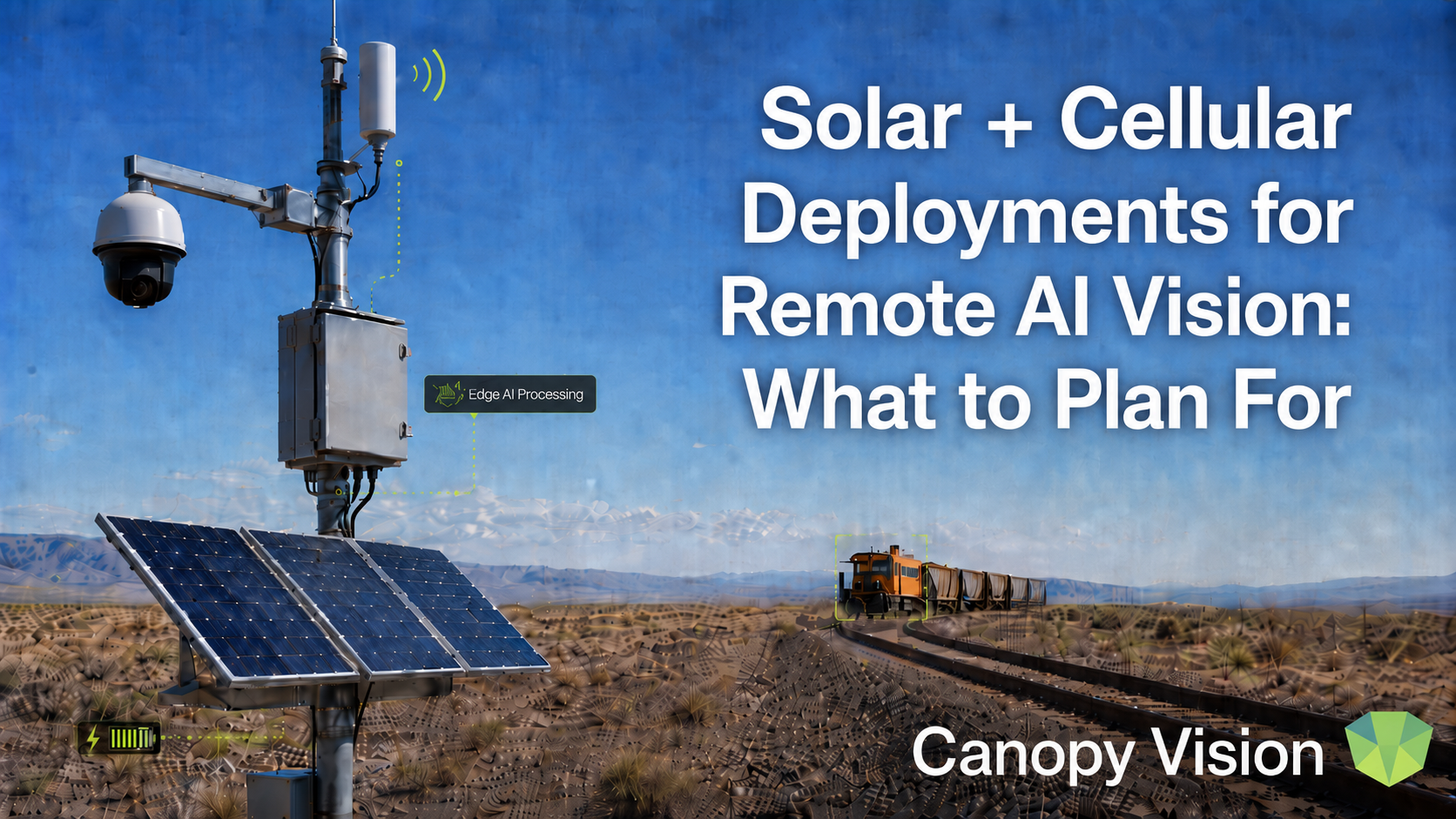
There are many industrial processes and operations that occur in remote locations where there isn't a convenient way to get power, Ethernet, or Wi-Fi. This can be at railroad tracks—including a remote AEI RFID reader at a yard entrance or exit—ditches and outfalls, truck loading and unloading stations, mining locations, or even on mobile equipment. Teams planning that kind of yard entrance deployment should also review what to consider before installing an AEI RFID reader. Even if there's some form of power available, good luck getting a stable network connection to the plant's corporate IT or OT network.
So how do we deploy AI vision in these remote locations?
We use a combination of solar panels and batteries for power, and cellular or Starlink connectivity for data. And the great thing is that, because the AI processing happens locally on a device next to the camera, you are not consuming large amounts of video data with a 24/7 real-time stream to some cloud server.
Canopy Vision has experience deploying solutions in remote environments and can handle sourcing and packaging all of the hardware needed, whether the device is being deployed in sunny Florida or snowy Idaho.
What Hardware Is Typically Required
Typically, a device that needs power and networking will need the following pieces of hardware (in addition to the camera and AI edge compute device):
- Solar panels — sized based on the power draw of all hardware and hours of sunlight expected. This power draw might range from 15W to 90W depending on the total number of cameras and the processing requirements of the solution.
- Batteries — also sized based on the power draw of the hardware and hours of sunlight expected. If the solution is deployed in an area that sees below-freezing temperatures, then a self-heating battery will be required if there's no other means of keeping the battery above 0°C.
- Solar controller — to manage the charging cycle of the battery and load.
- Solar telemetry unit — so we can monitor solar panel and battery status, load draw, and other electrical metrics that are helpful for troubleshooting issues remotely without a site visit.
- Cellular router — with a carrier-agnostic SIM card. This allows us to connect the device to the best network for the area. We partner with Helix Wireless to provide the best connectivity possible for remote environments. They are able to prioritize the SIM card for specific networks and even provide guidance on antenna placement.
- Cellular antennas — to boost cellular connectivity strength.
- Starlink modem and antennas — an optional upgrade if it's expected that 10 GB or more of data will be consumed per month. For projects where users will be streaming the cameras often or downloading large amounts of video data, this upgrade is worth the cost.
- NEMA enclosure — to protect the compute device, networking equipment, and power components from weather, dust, and harsh operating conditions.
- Power supplies, cables, and brackets — to connect everything together.
In some situations, this hardware can require poles or ground space for mounting and keeping equipment off the ground, with solar panels and antennas pointed at optimal angles.
How We Size a Remote Deployment Package
When we design a hardware package for remote deployment, we look at all factors, such as the expected power draw for the AI models (1 camera processing a classification model at 30 FPS consumes less power than 6 cameras running object detection models at 60 FPS). We also look at the hours of sunlight and expected weather at the location to determine solar panel and battery size.
Many teams start with pilot deployments that use solar power and cellular connectivity so the project can move forward without immediately connecting hardware to the customer's network. That approach works well, but hardware decisions still matter during the pilot phase — especially when the system is installed along railroad tracks, at mining operations, or in other harsh environments where a simple fix can take weeks.
Solar and cellular hardware also affects project cost. For more detail on how those components fit into the overall budget, see our article on what impacts the cost of an industrial AI vision project.
If you are interested in adding cameras at a remote location for detecting anything in your operations, consider using a Canopy Vision system with AI. Contact us today to get a quote for your next project.