While AI vision technology has been around for several years, many industrial facilities still have limited experience with it beyond standardized tools like license plate recognition, person detection, or basic intrusion alerts.
But that does not mean operations and maintenance teams are not thinking about it.
Whether it comes up during a safety incident root cause analysis, while dealing with a problem that has no traditional sensor, or after downtime occurs because operators did not notice something in the plant before it was too late, the question is often the same:
"Is there a way we can install a camera to detect this?"
That question is usually where the lifecycle of an industrial AI vision project begins.
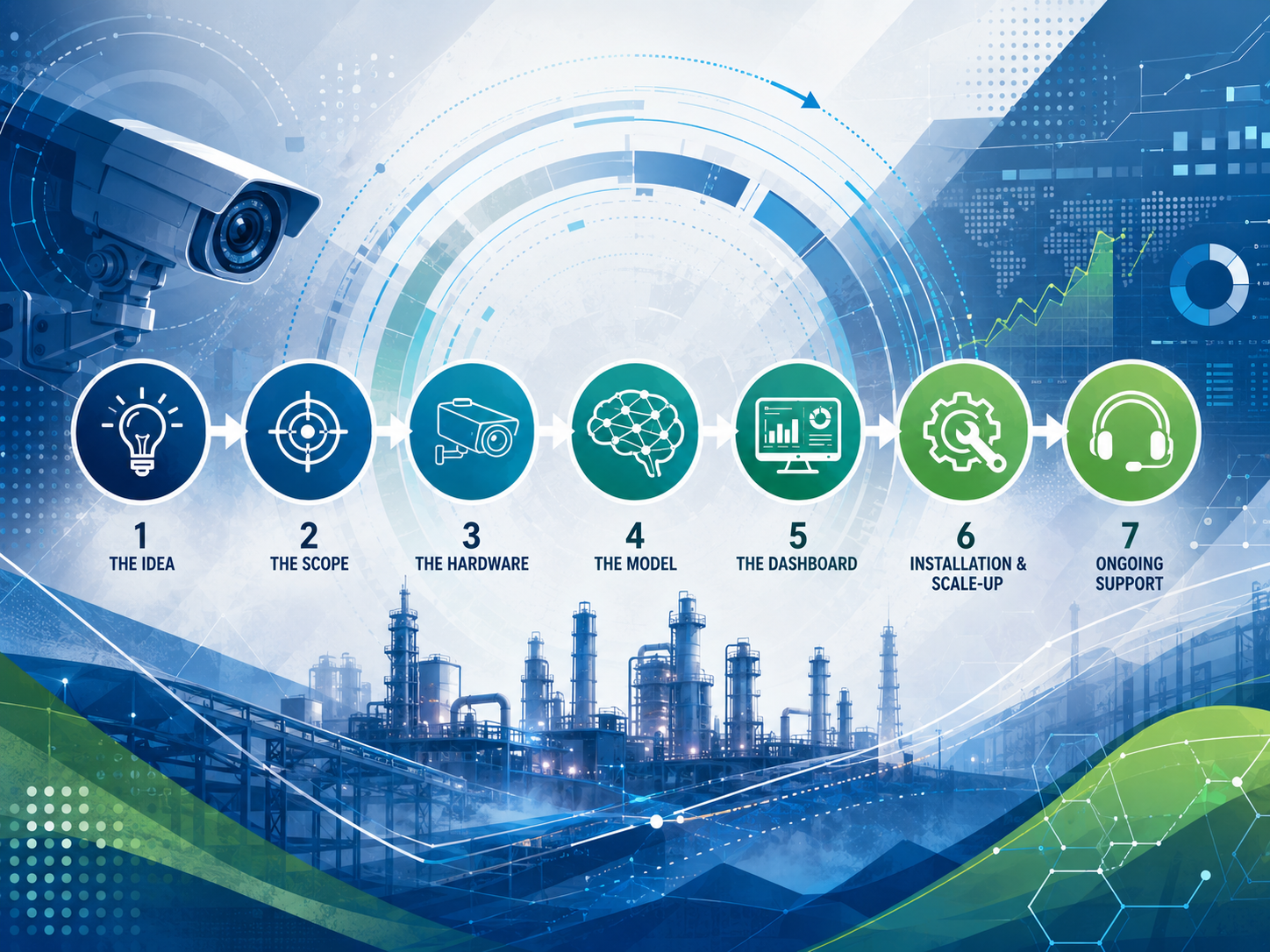
Stage 1: The Idea
When I speak with employees at industrial companies, I often ask a simple question:
"If we installed a camera there, would a person be able to tell if this event is happening?"
If the answer is yes, then AI vision may be a good option.
The next question I usually ask is:
"How often does this happen?"
If the event happens multiple times a year, then we may be onto something. The use case may occur often enough to collect useful data, justify the business case, and create a measurable operational improvement.
Not every idea is a good fit for AI vision, though. Some problems are better solved with other types of sensors or technologies.
For example, there have been projects where AI vision was not the right tool for the job:
- "I want to measure how many tons of material are being loaded into the top of a railcar." We tried it, but we could not get more accurate than the human eye. In that case, we would recommend LiDAR.
- "I want to see if an insulated pipe is plugging off."
- "I want to measure the thickness of material on a filter."
The first step is not forcing AI vision into every possible problem. The first step is determining whether the camera can actually see what needs to be detected, measured, or understood.
Stage 2: The Scope
Once an idea looks promising, the next step is defining the scope.
Whether you are working with Canopy Vision, an internal team, or another vendor, you need to clearly define what you are trying to detect or measure. You also need to determine what happens with the output data, what hardware will be required, who will install it, who will maintain it, who will develop the software, who will train the model, which models may be needed, and how the solution will fit into the facility's existing workflows.
At Canopy Vision, we have experience defining scope in a way that identifies the highest-risk areas early. Those risks may involve effort, cost, compliance, cybersecurity, IT/OT integration, or the complexity of the model itself.
For example, if a pilot project may eventually require PLC communication, we will usually try to design the pilot in a way that proves the solution without immediately connecting to the PLC or touching the customer's OT network. Once the business value has been demonstrated, the project has a much stronger justification before going through the necessary IT, OT, and cybersecurity review stages.
When you work with us, you will almost always see the scope presented in two phases:
- Pilot Phase
- Permanent Deployment Phase
The pilot phase is designed to prove feasibility, validate camera placement, train and test the model, and demonstrate the business value of the solution. The permanent phase is where the solution is hardened, integrated, scaled, and supported for long-term use.
At this point, the expected cost of the full solution should be understood, and all parties can either agree on the price or refine the scope as needed.
Stage 3: The Hardware
Once the project is approved, the first major step is getting the hardware built, installed, and configured.
In some cases, we can use existing cameras if the facility already has them. However, many AI vision projects require very specific camera placement, angles, lighting, and field of view. Because of that, existing cameras do not always work for the intended use case.
For pilot projects, we usually use lower-cost cameras without sophisticated self-cleaning features. Those features can be upgraded later if we determine they are needed during or after the pilot phase.
The other major hardware component is the AI compute device. Depending on the project, this may be a small, low-power edge device or a server capable of handling multiple parallel video streams.
For pilot deployments, we often supply a NEMA enclosure with the AI compute device, cellular modem, networking equipment, power equipment, and cables to the camera. For remote deployments where power is not available, additional solar and battery hardware may also be needed.
The goal during the hardware stage is to give the AI vision system a reliable view of the process, asset, equipment, or event it is expected to monitor.
Stage 4: The Model
Once the hardware is installed and powered, we can begin training the model.
Training the model requires enough image data for it to learn what the target event, condition, object, or measurement looks like across real operating conditions. That includes different lighting conditions, weather conditions, process states, angles, backgrounds, and edge cases.
Sometimes we can use techniques like data augmentation or synthetic data to generate enough training data when the event does not happen very often. Sometimes it only takes a few days to gather enough useful data. Other times, it may take several months.
During this stage, our team observes the camera feed and reviews the data to understand the full range of situations that occur in the field. We also gather and annotate enough diverse images for the model to learn effectively.
After the first model is trained, we continue reviewing data, gathering images, and annotating new examples. It usually takes multiple iterations before the model is accurate enough to be considered a working solution.
When possible, we define accuracy targets before the project begins and include those targets in the scope. That gives everyone a shared understanding of what success looks like.
This stage may also involve post-processing logic. Post-processing helps clean up the raw AI output and turn it into more actionable data. In many cases, the raw model output is only one part of the complete solution.
During model development, we may also discuss different model types, different camera placements, or physical changes in the field that could improve accuracy. In some projects, we combine multiple models together to improve the overall result.
At Canopy Vision, we also use specialized internal tools to monitor and quantify model accuracy during the active training phase and at any point in the future.
Stage 5: The Dashboard
As the model is being developed and refined, we may also begin work on the dashboard.
Some projects can use dashboards we have already built. Other projects require custom dashboards based on the customer's workflow, reporting needs, or operational goals.
The Canopy Vision platform makes it easy for us to build dashboards that link high-level data to timestamped video. This allows your team to see KPIs, trends, and specific video moments where events or measured values were observed.
When we build a custom dashboard, we are building more than a visualization tool for AI model outputs. We are working with your team to create something plant personnel can actually use.
That may mean tracking and trending process performance, monitoring railcar activity, optimizing loading and unloading operations, identifying recurring safety issues such as missed steps during hazardous truck unloading, or rolling measured data into financial reports.
The dashboard is where the AI vision system becomes more than a detection tool. It becomes a decision-support tool.
Stage 6: Permanent Installation and Scale-Up
Once the dashboard has been developed, the model has been running accurately, and the hardware is stable, the pilot phase can be considered complete.
At that point, the facility can move into permanent installation and scale-up.
If the AI vision solution needs to run on an OT network or communicate with plant PLCs, then the project will go through the appropriate IT, OT, and cybersecurity review process. If the solution needs to use the customer's SSO, such as Azure AD or Microsoft Entra, we will work with the proper IT resources to configure that as well.
If additional hardware is needed, we assist with that process.
Many short-term pilot feasibility studies involve temporary hardware with solar power and cellular connectivity. This allows the pilot to move forward without immediately connecting hardware to the customer's network.
When the project converts to a permanent installation, the models, post-processing logic, and dashboard can be transferred over seamlessly, even if the AI compute hardware changes completely.
That is one of the reasons we like structuring first projects as pilots. A well-designed pilot reduces risk, proves value, and creates a stronger foundation for long-term deployment.
Stage 7: Ongoing Management and Support
Beyond permanent installation, the remaining part of the lifecycle is management and support.
Because these solutions are often new, custom, and proprietary, support is an important part of long-term success. When you license Canopy Vision for long-term use, we include support and active management of the project as part of the ongoing license fee.
That means if you have an issue or would like something changed, you can call or email us directly and we will support the solution.
Over time, if your facility or company has enough projects with us, we can also shift some front-line support from our team to yours. This can help reduce the ongoing cost of the solution while giving your internal team more ownership over day-to-day support.
Final Thoughts
The first industrial AI vision project at a facility is rarely just about installing a camera or training a model.
It is about identifying the right operational problem, proving that the camera can capture the right data, building a reliable model, integrating the results into daily workflows, and supporting the solution as conditions change.
When the first project is scoped correctly, it creates a foundation that can make future AI vision deployments faster, easier, and more valuable across the facility.
If your team is exploring AI vision but is not sure which use case to start with, Canopy Vision can help evaluate your ideas and identify the best candidate for a pilot project.