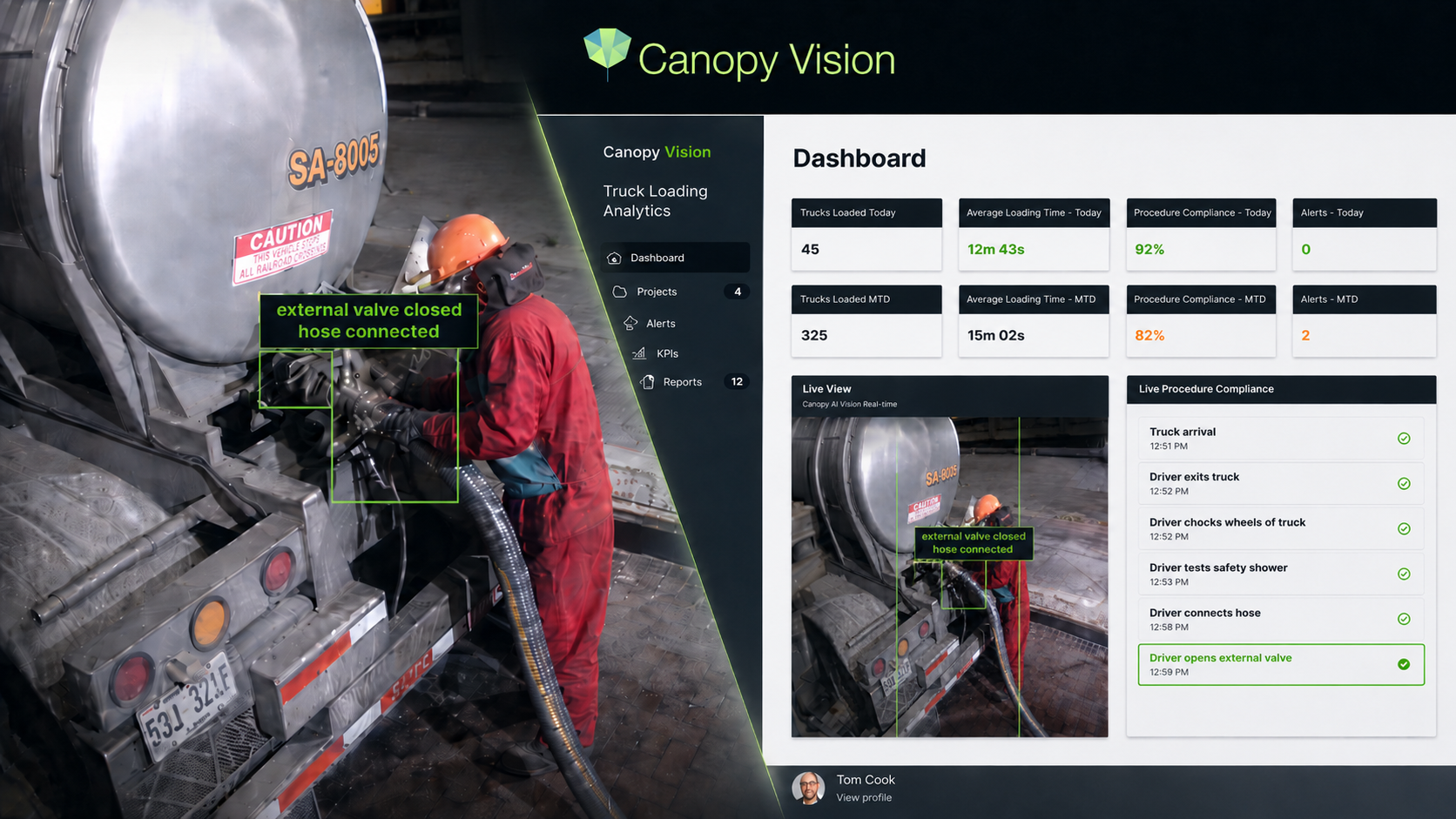
It is not uncommon for humans to be involved in processes at industrial facilities that carry elevated risk. Usually, there are controls available to reduce that risk, such as PPE, proper body positioning, lockout procedures, blocking and chocking, or other administrative controls. When those controls are not followed, employees face elevated risk that may lead to a serious accident or injury. Unfortunately, humans make mistakes. That is where another set of eyes can help.
Why Extra Eyes Are Hard to Staff
Traditionally, if there is a high-risk procedure, a facility might try to add extra oversight, such as having a supervisor walk the job down for approval or having a safety specialist observe the task. That does not happen for every job, and when it does, it rarely provides full 24/7 coverage. Many facilities instead start with a scoped AI vision pilot to prove value on one high-risk procedure before expanding coverage.
Sulfuric Acid Unloading at Scale
For example, at several large industrial facilities in Florida, highly concentrated sulfuric acid is shipped in tanker trucks. Some facilities unload more than 100 trucks of acid every day, around the clock. The procedure to unload acid from a truck has more than 20 steps, including many safety-specific steps and the operation of valves, hoses, and pumps in a specific order. If that order is not followed, highly corrosive acid can spray onto the employee and the surrounding area.
By the end of a 12-hour day, drivers may have made four or five trips and are fatigued on later unloads in the heat of a Florida summer. If a safety specialist were observing the process, that specialist could intervene if she noticed the driver forgetting to chock the wheels, failing to don PPE properly, or opening valves in the wrong order. Staffing a safety specialist position for 24/7 coverage requires four employees to cover those shifts, an approach that carries significant cost.
How AI Vision Monitors the Procedure
With AI-based vision systems like Canopy Vision, a single camera can observe the process and sound an alarm if an employee misses a step. By training AI models to detect specific steps and confirm their order matches the procedure, the system can observe and audit the process and intervene when needed. Coupled with the ability to write data to a PLC, the entire system can be shut down with an interlock if the procedure is not being followed.
Recorded Data for Coaching and Investigation
Because the data and videos are saved to a database through the Canopy Vision platform, you can run queries to understand which drivers and trucking companies are providing the safest, most efficient unloading operations for recognition, coaching, or contract review. If an incident were to occur, video recordings are available. A camera system can run 24/7 at a fraction of the cost of human staffing.
Contact us today to learn how Canopy Vision can observe, detect, and alert your team when hazardous procedures are not followed — before the next near-miss or safety incident occurs. See more examples in our use case library.