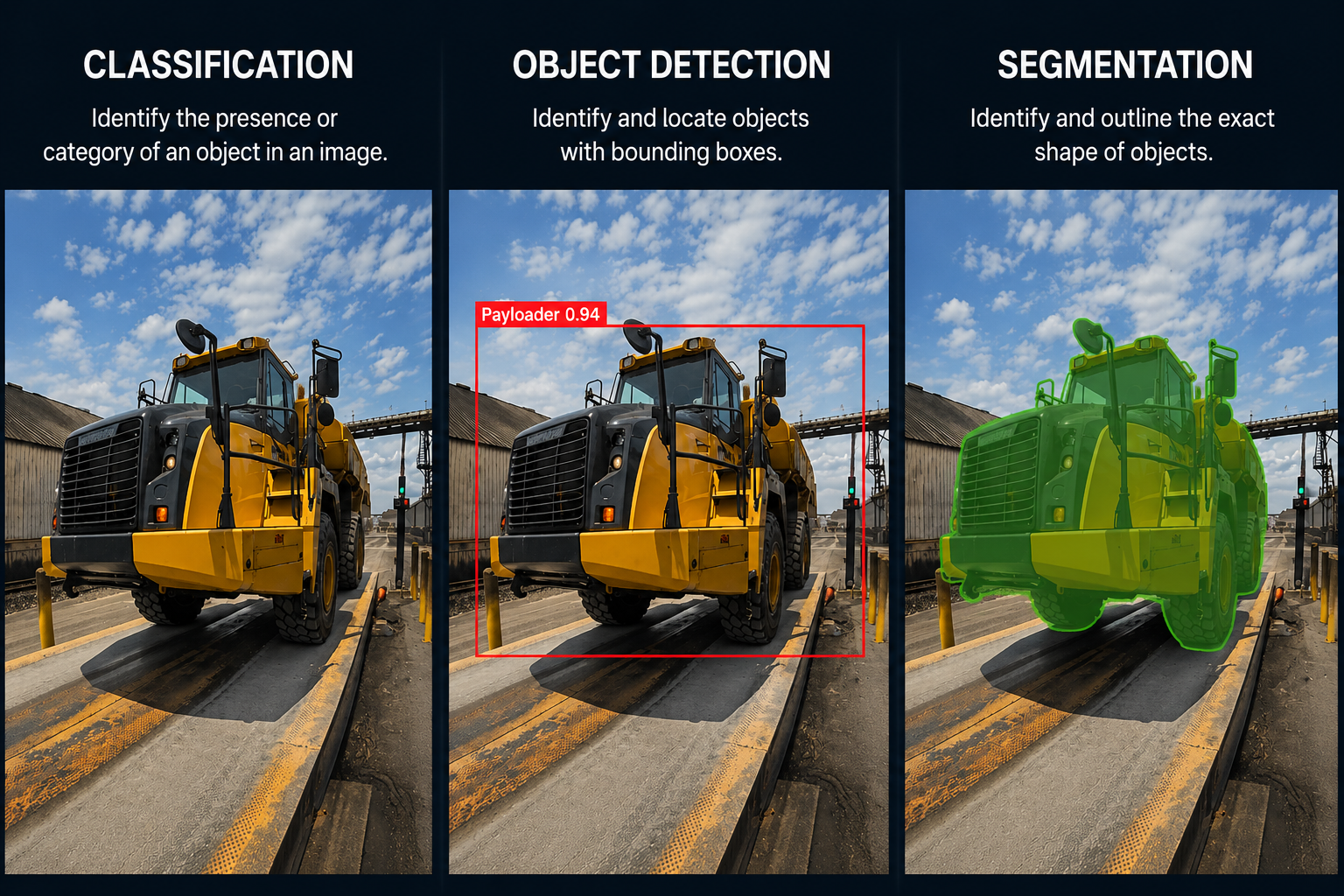
When you are faced with a problem in your industrial operations, it is natural to think that a camera plus AI could be a great way to solve it.
In many cases, that is true.
AI vision can often be one of the lowest-cost options for solving operational problems, especially when compared to traditional automation, new instrumentation, or major equipment modifications. A well-designed AI vision solution can provide strong value with relatively low maintenance costs and minimal upfront capital investment.
That said, the cost of an industrial AI vision project can vary depending on the use case, environment, hardware requirements, deployment complexity, and long-term support needs.
The primary cost factors usually fall into three categories:
- Hardware and installation costs
- Software and AI development costs
- Ongoing licensing, support, and maintenance costs
Understanding these categories early can help teams scope a realistic pilot, avoid unnecessary costs, and make better decisions about how to scale AI vision across a facility.
Hardware and Installation Costs
For most AI vision projects, hardware costs are fairly straightforward to estimate.
You can usually get quotes for cameras, compute hardware, enclosures, brackets, cables, networking equipment, solar power, cellular connectivity, and any other required components. For rail yard entrance projects, planning an AEI RFID reader deployment helps clarify how many pass-by points you need before hardware quotes are meaningful.
For a single-camera project that does not require solar power or cellular connectivity, the hardware can often cost less than $8,000.
However, hardware cost is only part of the equation.
In some projects, installation costs can far outweigh the hardware itself. This is especially true when cameras need to be installed in locations with limited access, such as areas that require a high reach, scaffolding, special safety procedures, or downtime coordination. Installation can also become more expensive if camera cables need to be routed through multiple cable trays or across difficult areas of the facility.
For larger projects with multiple cameras, especially projects that need to connect to an OT network, additional costs may include network switches, industrial enclosures, configuration, cybersecurity review, and integration support.
When we are asked to submit a proposal for a new project, we usually try to scope the lowest-cost practical pilot first. The goal is to minimize hardware costs while still giving the customer a reliable way to confirm that the AI vision solution works well enough to justify permanent deployment or broader scale-up.
In other words, we try not to overbuild the first version of the project.
A pilot should prove the concept, validate the camera placement, and demonstrate business value before the customer commits to a permanent deployment or a larger multi-camera rollout.
Planning Hardware for Future Projects
When we propose hardware for an AI vision project, we often ask about future projects as well.
That is because the hardware quoted for one project may be useful for additional AI vision projects later.
With proper planning, a single multi-GPU server can potentially support 10, 30, or even 100 parallel camera streams, depending on the models, frame rates, resolution, and processing requirements. As more projects are added, GPUs and hard drive storage can be expanded over time.
This approach can be much more cost-effective than installing a separate edge compute device for every individual project.
However, it does require planning ahead and may involve a higher initial investment.
For facilities that expect to deploy multiple AI vision use cases over time, it may be worth designing the compute architecture with future projects in mind. For facilities testing one specific use case, a smaller pilot setup may be the better starting point.
The right answer depends on the facility's goals, budget, timeline, and long-term AI vision strategy.
Software and AI Development Costs
The second major cost factor is software and AI development.
If you are building an AI vision solution internally without third-party contractors or licensed software, the amount of time required can vary significantly depending on your team's experience with industrial AI vision.
There is a major difference between training a model on someone's computer and deploying a reliable real-time AI vision solution in an industrial environment.
We often see cases where an internal team trains an AI model and gets everyone excited about the results. The model may look great in a demo or during early testing. But once the team tries to deploy it in real time at the plant, issue after issue begins to appear.
The model may struggle with lighting changes, camera positioning, environmental conditions, network constraints, compute limitations, or integration requirements. It may also be difficult to maintain if the person who originally developed the model changes roles or leaves the company.
When that happens, the project can become stranded.
The system may stop working, lose accuracy, or require changes that nobody else on the team knows how to make. This is one of the most common reasons internal AI vision projects get abandoned after the initial excitement wears off.
Why Experience Reduces Cost and Risk
When you work with Canopy Vision, you are not just paying for model development. You are working with a team that has been through enough projects to understand what it takes to get from idea to successful deployment.
That experience matters.
We have developers and project managers who understand the full lifecycle of an industrial AI vision project, including hardware selection, camera placement, model training, edge deployment, dashboard development, support, and long-term maintenance.
Because our platform was built specifically for these types of projects, we are usually able to move quickly and reduce the amount of custom development required.
That can make the overall project cost lower than hiring outside developers or trying to build everything from scratch internally.
We also typically propose fixed-price engagements when possible because we understand the level of effort involved and can usually estimate the time and cost upfront.
For customers, that creates a clearer budget, lower uncertainty, and a more predictable path from pilot to deployment.
Ongoing Costs and Long-Term Support
The third major cost factor is ongoing support.
If you build an AI vision solution internally, you may not have a direct software licensing or support cost. But you still need to maintain internal expertise for troubleshooting, model updates, system changes, and long-term support.
With vision projects, conditions in the plant or physical environment can change over time. Those changes may reduce model accuracy.
For example, imagine a vision system that detects chute pluggage and shuts down upstream equipment. If the chute gets a new liner, or if a light is replaced with one that has a different light profile, the model accuracy could drop significantly.
Suddenly, a system that used to work well may become unreliable.
If the original developers are no longer in the same roles, it can take a lot of work for a new developer or team to understand how the system was built, how the model was trained, and how to retrain it properly.
This is where internal projects often lose momentum. The system that everyone spent time, effort, and money developing becomes another abandoned tool.
The Value of a Standard Platform
When you work with a third party like Canopy Vision, the long-term support model is different.
We use standard procedures and a common Canopy Vision platform, which makes model retraining, updates, and support much faster and easier. In many cases, model retraining can cost less than $1,500, depending on the scope of the change and the amount of new data required.
The tradeoff is that Canopy Vision does have a licensing and support cost for the platform.
The benefit is that the project does not depend on one internal developer or a one-off custom build. It is supported by a repeatable process, an experienced team, and a platform designed for long-term use in industrial environments.
As a facility adopts more Canopy Vision projects, the licensing and support cost can also go down on a per-project basis. That makes the economics more attractive as AI vision expands across the operation.
Final Thoughts
The cost of an industrial AI vision project is not determined by the camera alone.
It is shaped by the hardware, installation complexity, compute requirements, software development effort, model training, integration needs, support model, and long-term plans for scale.
A low-cost pilot can be a smart way to prove the value of AI vision before committing to permanent infrastructure. At the same time, facilities that expect to deploy multiple AI vision projects should think carefully about hardware and platform decisions early, because the right architecture can reduce costs over time.
The most successful projects are usually the ones that balance short-term practicality with long-term planning.
If your team is considering an industrial AI vision project, the best place to start is with a clear use case, a realistic pilot scope, and a plan for how the solution will be supported after it starts delivering value.