If you have spent time in an enterprise organization, you have probably seen new technologies come and go.
A new pilot starts with excitement. Teams are curious. Leaders want to see what is possible. The technology gets discussed in meetings, shared across departments, and sometimes even brought up at the executive or board level.
Then, over time, the energy fades.
The pilot takes longer than expected. The scope expands. The original champion moves to another role. The budget conversation becomes more difficult. Eventually, a project that once felt promising gets abandoned, delayed, or quietly left behind.
There are many reasons why technology pilots fail to move beyond the pilot phase. In this article, I'll focus specifically on AI vision projects, but many of these lessons apply to other technology pilots as well.
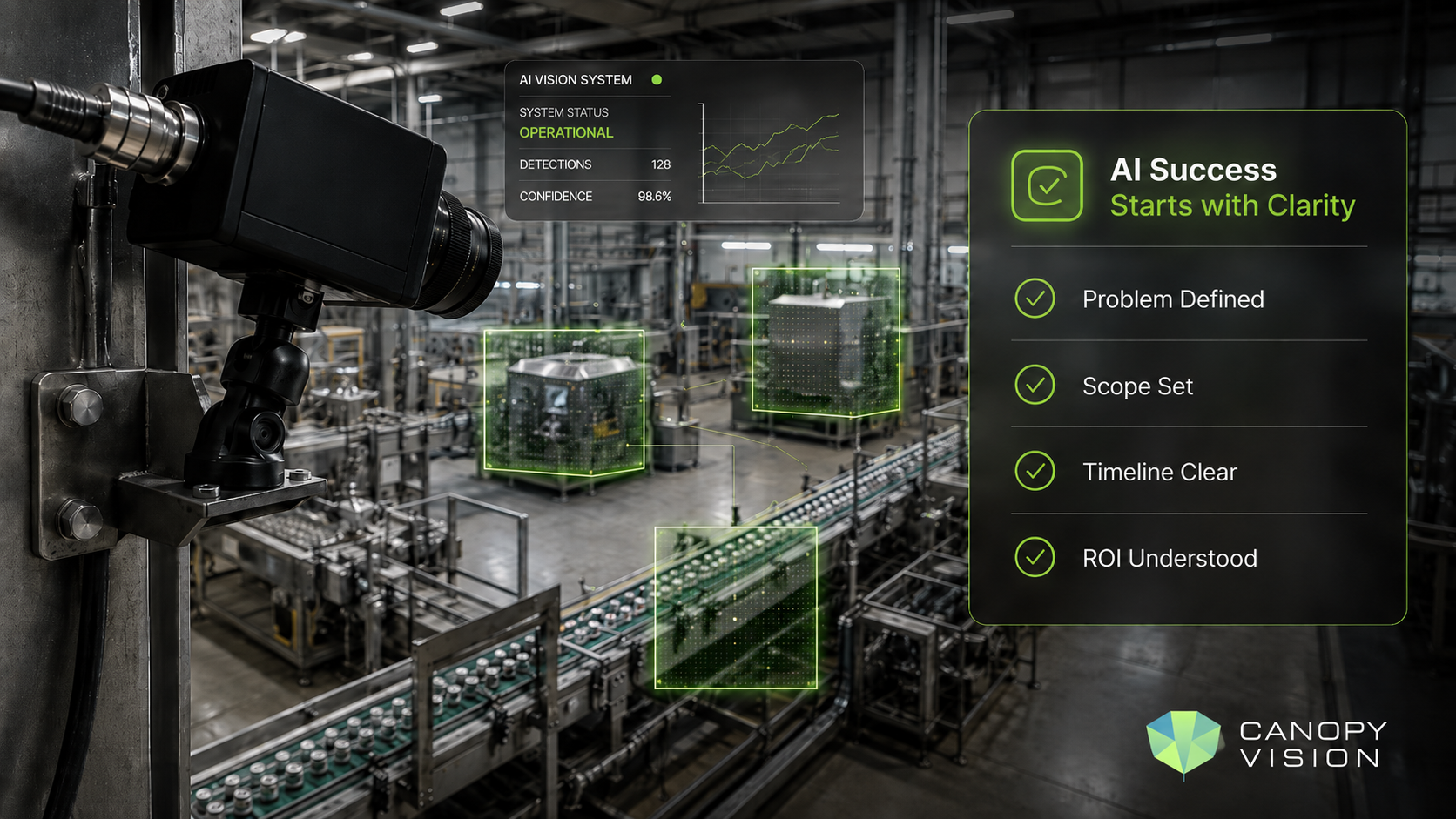
For an AI vision pilot to succeed, the goal cannot simply be to "try AI" or "see what happens." Success has to be defined clearly enough that the team knows what problem is being solved, what value is being measured, what timeline matters, and what needs to be true for the solution to become permanent — themes we explore throughout the lifecycle of a facility's first industrial AI vision project.
1. The Pilot Takes Too Long
One of the most common reasons pilots fail is simple: they take too long.
Human attention is a limited resource. When a facility begins a pilot for an exciting new technology, there is usually a lot of initial momentum. People are interested in the "cool new tool." They want to see demos. They want to understand how it works. They want to imagine what it could do for their operation.
We have seen this many times at Canopy Vision. When we first start discussing AI vision and sharing video examples, the project can quickly get attention beyond the immediate site team. In some cases, projects have been shared with senior leadership, boards of directors, or during company town halls.
That excitement is useful, but it does not last forever.
If you are the internal project lead, you have to capitalize on that momentum while it is still there. If a pilot lasts a full year, then by the time the team is ready to decide whether to support long-term adoption, the motivation may be much lower than it was at the beginning.
This can happen even if the pilot was technically successful.
The project may have delivered value. It may have shown a positive return on investment. But if the decision point comes too late, the environment around the project may have changed. The main champion may have moved to another department or company. Market conditions may have shifted. A different initiative may have taken priority. The organization may simply no longer have the same appetite to push the project forward.
At Canopy Vision, the Canopy Vision platform has helped us shorten the pilot phase from one year to closer to three months whenever possible. Some projects do require longer evaluation periods, especially if the events being detected are rare or the environment is complex. But when a pilot can be structured around a three-month timeline, we have found that it is much more likely to maintain the traction needed for long-term adoption.
A successful pilot should be long enough to prove the technology, but short enough to preserve organizational momentum.
2. The Team Prioritizes the Technology Over the Problem
Another reason pilots struggle is that they start with the solution instead of the problem.
This often happens when a facility gets excited about a new technology and wants to experiment with it. Someone may say, "There is this interesting startup doing something with AI. Where could we test it?"
From there, the team looks for a problem that might fit the technology.
A stronger starting point is a defined operational problem with clear safety risk — for example, monitoring hazardous truck unloading procedures where missed steps can lead to serious injury.
That does not necessarily mean the selected problem will justify long-term investment. A facility and a vendor may work together on a low-cost pilot, only to find out later that the use case does not meet the ROI requirements needed for permanent funding.
Sometimes the vendor does not realize this. Sometimes the internal team does not realize it either. Everyone may simply be treating the pilot as an interesting experiment.
That is not always a bad thing.
There is value in exploring new technology before every detail is fully understood. Forward-thinking companies should be open to learning, experimenting, and engaging with new vendors. The issue is not exploration itself. The issue is failing to define the purpose of the pilot upfront.
If a project is being funded primarily for learning, that should be clear from the beginning. Everyone should understand that the goal is to explore the technology, understand the effort required, and learn what types of problems it may be able to solve.
If a project is being funded to solve a specific operational problem, then the value of that problem needs to be understood early. The team should know what the current pain point costs, what improvement would be meaningful, and what level of investment would make sense for long-term deployment.
This discussion also needs to include the long-term cost of the solution. A pilot may be inexpensive, but a permanent system usually includes licensing, maintenance, support, hardware, networking, and future expansion costs.
If those costs are not discussed until the end of the pilot, the budget owner may experience sticker shock. At that point, even a technically successful pilot may fail to receive approval.
At Canopy Vision, when we propose a pilot project, we provide guidance on what long-term implementation would likely cost, including licensing, maintenance, and support. The goal is to make sure the pilot is not being evaluated in isolation. It should be evaluated as the first step toward a system that could realistically be supported over time.
3. The Scope Expands Without Clear Boundaries
It is normal to start a new technology pilot without knowing exactly what the final solution will look like.
There may be dashboard changes, report requests, hardware adjustments, user interface updates, or integration needs that only become clear once the project is underway. Some flexibility is healthy. A pilot should allow the team to learn.
The problem starts when every new idea becomes part of the pilot scope.
Without clear boundaries, requested changes can make the pilot longer, more expensive, and harder to evaluate. Vendors and internal teams often want to keep the end user happy, so they agree to additional requests. On the surface, that can feel like a good sign. It may seem like the users are engaged and the project is going well.
But more requests do not always mean more value.
Sometimes scope changes come from open-ended discussion. Someone sees a dashboard and asks for another feature. Someone else wants a different report. Another group wants to add a related use case. These may all be reasonable ideas, but they still need to be reviewed against the purpose of the pilot.
If the team keeps adding "nice-to-have" features before proving the core value, the pilot can quickly run into the same issues described earlier. It can take too long. It can become too expensive. It can become harder to connect the solution to a clear ROI.
A good pilot should separate the core success criteria from future enhancements, much like the distinct pilot and permanent deployment phases described in our article on the lifecycle of an industrial AI vision project.
The question should be: What do we need to prove in order to decide whether this technology is worth adopting?
Everything else can be captured as part of a long-term roadmap.
4. The Technology Does Not Work for the Use Case
Sometimes the technology simply does not work.
A team may try to implement a new tool, product, or system, only to discover that it cannot deliver what is needed. With AI vision projects, this can happen for several reasons.
The event being detected may not happen often enough to train or validate the model. The visual conditions may be too inconsistent. The camera angle may not provide enough useful information. The site may require complex post-processing logic that is difficult to implement reliably. The problem may be better solved with a different type of sensor or process change.
This does happen.
However, many of these risks can be reduced by working with people who already understand the technology and its limitations.
At Canopy Vision, we will tell you if we do not think a vision solution is a good fit. We have seen firsthand what can cause AI vision projects to fail, and we do not want to engage on a project if we believe the technology is unlikely to work.
This is also why we like to host technical lunch and learns with site personnel. The goal is to help teams understand the types of problems AI vision is good at solving and the types of problems where it may struggle.
That is not because we are trying to find a problem for a solution. It is because many facilities do have problems that vision is well suited to solve. The key is knowing how to recognize the right use cases — including those illustrated in our use case library — before time and budget are spent on the wrong ones.
5. Hardware Issues Slow the Pilot Down
With AI vision projects, the software is only part of the system.
In most cases, new hardware needs to be installed. That may include industrial cameras, self-cleaning camera systems, solar and cellular packages, edge devices running AI models, enclosures, networking equipment, and power infrastructure.
These systems are often installed in remote or harsh locations. They may be placed along railroad tracks, at mining operations, near heavy equipment, or in areas that require special access equipment such as a manlift.
When hardware fails in those environments, a simple issue can take weeks or months to fix.
A camera may need to be repositioned. A network connection may need to be improved. A power issue may need to be investigated. A technician may need to travel to the site. In some cases, additional spending approval may be required just to complete the fix.
The longer these issues drag on, the more the pilot loses momentum.
End users may start to question whether the system is reliable enough for permanent use. Leaders may wonder whether the technology is practical. The pilot timeline stretches, and the project becomes harder to defend.
This is why hardware decisions matter, even during the pilot phase.
It may be tempting to use low-cost consumer-grade parts to keep early costs down. In some cases, that may be reasonable for a controlled test. But if the pilot depends on hardware that cannot survive the real operating environment, the project may be set up to fail before it starts.
For AI vision pilots, hardware reliability is not a secondary detail. It is part of the solution.
How to Improve the Chances of Pilot Success
No one starts a technology pilot hoping it will fail.
Even though enterprise technology pilots have a high failure rate across many industries and technologies, there are practical ways to improve the odds of long-term adoption.
One of the best things you can do is ask vendors about projects that did not result in permanent deployment.
Pay attention to the answer.
Are they candid about past failures? Can they explain what went wrong? Do they have specific examples of pilots that failed because of timeline, scope, hardware, ROI, site conditions, or technical limitations?
If a company cannot provide any examples, that may be a warning sign. They may be choosing not to talk about failed projects, or they may not have enough implementation experience yet. No company has a 100% success rate with new technology deployments, no matter how good they are.
Another useful step is to involve the developers, engineers, or technical personnel early in the process. If the conversation only includes salespeople, solution specialists, or managers, the project may stay at the hype level for too long.
The technical team can often identify critical issues early. They can assess camera placement, data availability, model feasibility, networking requirements, hardware constraints, and integration complexity before the pilot begins — the same factors covered in the early stages of the lifecycle of an industrial AI vision project.
Finally, do not enter the pilot phase with a rigid mindset.
If the project is truly testing new technology, the team may need to think creatively about how to prove the most important parts of the solution within a practical timeframe. Not every final requirement needs to be solved during the pilot.
The pilot should focus on the unknowns that matter most.
Can the technology solve the problem? Can the vendor deliver? Can the system perform in the real operating environment? Does the solution create enough value to justify long-term investment?
If those questions can be answered clearly, the remaining details can often be addressed as part of the permanent implementation plan.
Defining Success Before the Pilot Begins
A successful AI vision pilot is not just a pilot that produces an interesting demo.
A successful pilot gives the organization enough confidence to make a decision.
That decision may be to move forward with a permanent deployment. It may be to expand to additional use cases. It may be to pause because the ROI is not strong enough. It may even be to stop because the technology is not the right fit.
Any of those outcomes can be valuable if the pilot was structured correctly.
The real failure is when a pilot ends and no one knows what was proven, what value was created, what it would cost to continue, or what decision should come next.
For AI vision projects, success should be defined before the first camera is installed. The team should understand the problem, the timeline, the decision criteria, long-term cost, and the conditions required for adoption.
When those pieces are clear, an AI vision pilot has a much better chance of becoming more than an experiment.
It becomes a practical step toward solving a real operational problem.