Most industrial rail loadout stations have a scale that weighs the railcar before and during loading. This allows operators to ensure they are loading the car with as much material as possible without exceeding the car’s maximum Gross Weight on Rail (GWR). Since every car has a slightly different weight when empty (the Tare Weight), each car has a Load Limit that can be added to the car before it reaches its maximum GWR.
This is all straightforward — load your railcars up to the maximum allowed by the rail operator to maximize your rail efficiency.
When You Don’t Have a Scale at Every Loadout
But what if you don’t have a scale? Scales are an expensive capital project, and depending on your site layout, you might have multiple loadout stations without a scale underneath them. Instead, these facilities may rely on a single scale near the exit to capture legal-for-trade measurements before railcars leave the facility.
At facilities like this, operators might be loading by eye, which can cause cars to be overloaded or not filled to their maximum capacity. Understanding what drives project cost can help teams compare new scale installations with sensor-based alternatives.
Unloading Without a Scale at Receipt
If you receive railcars to unload but don’t have a scale at receipt, your operations may rely on the weights reported by the rail operator or the facility that loaded the cars. Small errors, spills, or other data inaccuracies can lead to incorrect reporting of the material being unloaded, resulting in inventory write-downs or yield calculation errors.
Similar challenges exist in other receiving operations. For example, facilities monitoring truck unloading procedures with AI vision can use cameras to provide an additional record when manual checks aren’t enough.
Volumetric Measurement With Cameras and LiDAR
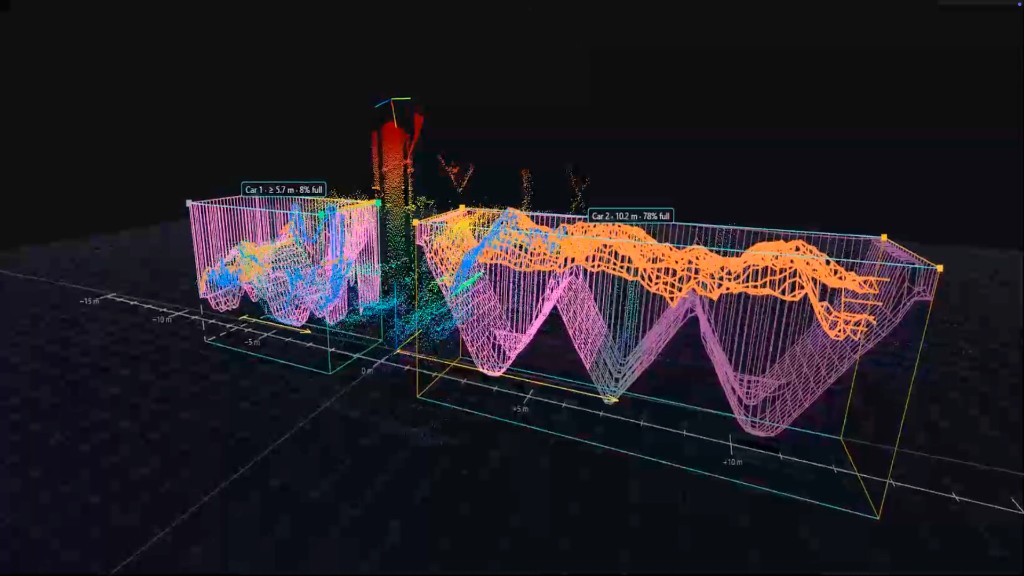
Canopy Vision has partnered with Altamus, a leader in industrial LiDAR solutions, to provide a low-cost volumetric railcar measurement solution. By combining cameras and LiDAR, the system can measure the volume of material being loaded into a railcar or the volume before and after unloading.
The system can also work in operations where railcars move during loading, allowing operators to estimate loaded quantities without waiting for the car to pass under a fixed LiDAR scanner.
Here’s how the two technologies work together:
- Canopy Vision provides the cameras, AI vision, and platform that track the railcar as it moves through the loading process. This brings together the measurements, video, and railcar information in one place. Altamus provides the LiDAR sensors and technology needed to measure the volume of material in the car.
- When cars move during loading, both technologies play an important role. The cameras help keep track of which car is being loaded, while the LiDAR continuously measures how much material is in the car. This gives operators a real-time estimate of how much they’ve loaded, rather than relying on visual estimates or waiting until loading is complete.
Altamus also shares their perspective on the partnership, including their work with LiDAR sensors and point cloud processing.

For facilities that also need to track railcar identity and movement, volumetric measurements can complement AEI RFID and camera pass-by tracking and broader automated railcar tracking within the yard. Measurements and video can also be managed through the Canopy Vision platform alongside other rail and process-monitoring applications.
Volume, Density, and Existing Scales
With LiDAR, the data is volumetric, requiring a material density to convert the volume to weight (tons). For operations with highly variable material densities, this solution may not be ideal.
On the other hand, facilities that already have a scale can use this solution to gather real-time, car-by-car density measurements. By combining volumetric data with the scale output, operators can calculate each car’s density without relying on manual samples or other error-prone autosamplers.
If your facility has loading or unloading operations and would like to understand whether a Canopy Vision / Altamus LiDAR solution can help, please contact sales@canopy-vision.ai or reach out through our contact form.
You can also explore our other rail solutions and examples in our use case library.